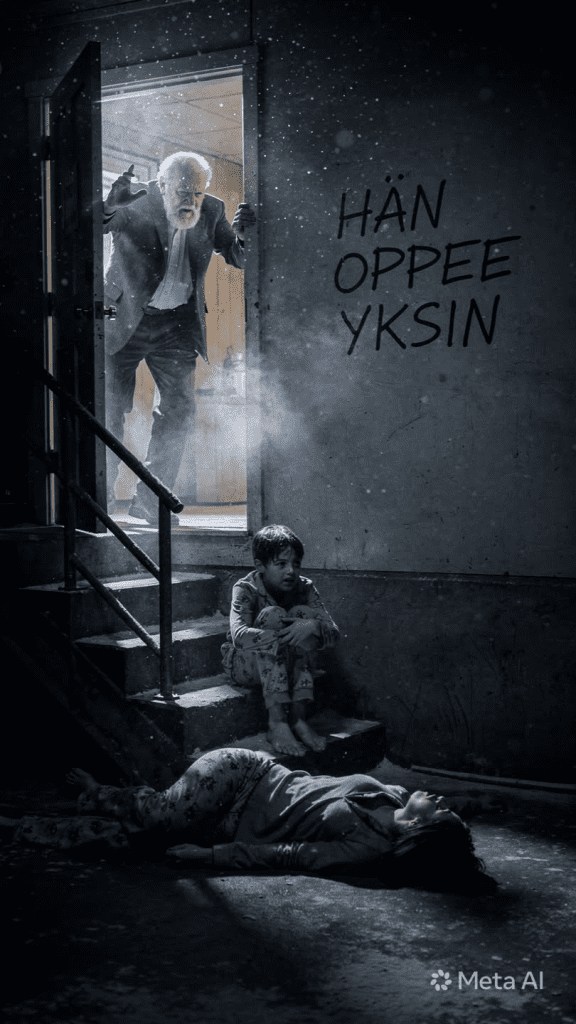
Pojanpoikani Noah oli kuusivuotias, eikä hän koskaan soittanut minulle, ellei tyttäreni Claire auttanut häntä. Joten kun puhelimeni soi perjantai-iltana kello 21.43 ja kuulin hänen pienen, vapisevan äänensä kuiskaavan: ”Ukki, minua pelottaa. Auta minua”, kurotin jo takkiani kohti.
Ulkona lumi pamahti Vermontissa sijaitsevan taloni ikkunoita vasten kuin kourallinen soraa. Tiet olivat lähes näkymättömiä lumimyräkässä, mutta ajoin silti puristaen rattia ja ajovalojen taistellessa valkoisen lumen läpi.
– Noah? sanoin pitäen hänet kaiuttimella. – Missä äitisi on?
Hän niiskutti. ”Hän ei herää. Isä sanoi, että olin paha. Hän lukitsi minut kellariin.”
Sydämeni putosi.
”Kuuntele minua”, sanoin. ”Pysy paikallasi. Minä tulen.”
Linja meni mykäksi.
Soitin Clairelle kaksitoista kertaa. Ei vastausta. Soitin vävylleni Markille. Suoraan vastaajaan.
Siihen mennessä kun saavuin heidän talolleen, käteni olivat tunnottomat lämmittimestä huolimatta. Heidän kuistinsa valo oli sammunut. Ajotiellä ei näkynyt renkaanjälkiä, paitsi yksi tuore, puoliksi lumen peittämä.
Koputin oveen.
Mark avasi sitä vain muutaman sentin. Hänellä oli yllään farkut ja harmaa collegepaita. Hänen hiuksensa olivat märät, aivan kuin hän olisi juuri käynyt suihkussa, mutta hänen kaulassaan kulki punainen naarmu.
– Richard? hän sanoi räpytellen silmiään liian hitaasti. – Mitä helvettiä sinä täällä teet?
“Missä Nooa on?”
“Hän nukkuu. Lakkaa keksimästä asioita.”
“Hän soitti minulle.”
Markin leuka jännittyi. ”Lapset näkevät painajaisia.”
“Liikkua.”
Hän astui oviaukkoon ja esti minua olkapäällään. ”Claire on sairas. Noah voi hyvin. Mene kotiin ennen kuin kuolet näihin teihin.”
Hänen takanaan, jostain talon sisältä, kuulin vaimean tömähdyksen.
Sitten toinen.
Työnsin hänet ohi.
Mark tarttui minua käsivarresta. ”Et tule minun talooni tälläisenä.”
Kierähdin irti ja kävelin käytävää pitkin. Talossa haisi oudolta – valkaisuaineelta, viskiltä ja joltain metallilta. Clairen käsilaukku makasi läikkyneenä lattialla portaiden lähellä. Hänen puhelimensa oli säröillä sen vieressä.
“Nooa!” huusin minä.
Pieni ääni huusi alhaalta. ”Ukki!”
Mark syöksyi kimppuuni, mutta olin nopeampi kuin hän odotti. Tökäsin olkapääni häneen ja pääsin kellarin ovelle. Tuoli oli juuttunut ovenkahvan alle.
Kun vedin sen sivuun ja avasin oven, kylmää ilmaa nousi alhaalta.
Katsoin alas.
Noah istui betonilattialla pyjamat yllään, paljain jaloin, polviaan vasten. Claire makasi liikkumattomana portaiden alapäässä, toinen käsivarsi koukussa vartalonsa alle.
And on the wall behind them, written in black marker, were the words: “HE LEARNS WHEN HE’S ALONE.”
For one second, the world became silent except for Noah’s crying.
Then Mark hit me from behind.
My shoulder smashed against the basement doorframe, and pain flashed across my ribs. I grabbed the railing before I fell. Mark cursed and reached for my jacket, but I kicked backward and caught his shin. He stumbled, swearing through clenched teeth.
“Noah, don’t move!” I shouted.
I pulled my phone from my pocket and dialed 911 with shaking fingers. Mark saw the screen and rushed me again.
“You don’t know what happened,” he snarled. “Claire fell. The kid was hysterical. I was handling it.”
“By locking him in the basement?”
His face hardened. “He lies. Just like his mother.”
The dispatcher answered.
I yelled the address and said, “Child trapped, woman unconscious, violent man in the house.”
Mark slapped the phone from my hand. It skidded across the kitchen floor, still connected.
From downstairs, Noah screamed, “Grandpa!”
That sound put thirty years back into my legs. I drove my elbow into Mark’s stomach and shoved him against the refrigerator. Magnets and school photos scattered. One photo landed faceup near my boot: Noah grinning with missing front teeth, Claire’s arms around him, Mark standing beside them with a hand too tight on Claire’s shoulder.
Mark recovered and reached into a kitchen drawer.
I saw the knife handle.
I grabbed the nearest thing I could find—a cast-iron skillet from the stove—and swung it into his wrist. The knife clattered across the tile. Mark roared, clutching his arm.
“You old bastard,” he said.
“Stay down.”
He didn’t. He came at me again, all rage and panic. We crashed into the dining table. A chair broke under our weight. My ribs screamed. He was younger, stronger, and desperate, but I had one advantage: I wasn’t fighting to win. I was fighting to reach my family.
Outside, sirens wailed faintly through the storm.
Mark heard them too.
His expression changed. Not fear exactly—calculation. He bolted for the back door.
I didn’t chase him. I ran to the basement.
Claire was breathing, shallow but steady. Blood had dried near her hairline. Noah crawled into my arms so hard he almost knocked me over. His skin was icy.
“I tried to wake Mommy,” he sobbed. “Daddy got mad because I spilled water. He said I needed to learn. He turned the lights off.”
I wrapped him in my coat. “You did the right thing calling me.”
“I used Mommy’s old phone,” he whispered. “The one in the laundry basket.”
Two deputies arrived first, then paramedics. Mark didn’t make it far. His truck had slid into a snowbank behind the house. They found him half a mile down the road, still wearing house slippers, his wrist swollen and his clothes wet from falling in a ditch.
At the hospital, Claire woke near dawn. Her first words were not about herself.
“Where’s Noah?”
I held her hand. “Safe.”
She closed her eyes, and tears slid into her hair.
But safety was not the same as peace. By noon, detectives were asking questions. By evening, Child Protective Services had arrived. And by Monday morning, Mark’s attorney was already calling it “a domestic misunderstanding aggravated by weather, stress, and alcohol.”
That was when I realized the nightmare had not ended in the basement.
It had only moved into court.
The first time I saw Mark after that night, he was wearing a navy suit and a clean white shirt, with his injured wrist wrapped neatly in a brace. He looked nothing like the man who had blocked the door during the blizzard. He looked calm. Respectable. Almost offended to be there.
Claire sat beside me in the courthouse hallway, one hand on Noah’s small backpack. Her face had healed, but the bruising behind her eyes had not. She kept glancing toward the courtroom doors as if they might open and swallow her.
Noah was not in the courtroom. A victim advocate had taken him to a child-friendly waiting room with toys, books, and a therapy dog named Jasper. Still, every few minutes Claire asked, “Can someone check on him?”
I understood. Since the basement, Noah hated closed doors. He slept with a flashlight under his pillow. When the furnace clicked on at night, he ran to Claire’s bed without making a sound. He had learned to be quiet when afraid, and that broke something in me every time I thought about it.
Mark’s attorney stood in front of the judge and spoke smoothly.
“My client denies intentionally harming his wife or child. Mrs. Bennett fell during an argument. Mr. Bennett admits he panicked, but he maintains he placed the child downstairs temporarily for safety after the child became uncontrollable.”
Claire flinched at the word “uncontrollable.”
I leaned toward her. “Breathe.”
The prosecutor rose next. Her name was Dana Whitcomb, and she had the sharp, steady voice of someone who did not waste words.
“Your Honor, the state has medical records, the 911 call, the child’s recorded forensic interview, photographs from the scene, and evidence of prior controlling behavior. The defendant locked a six-year-old child in an unheated basement while the child’s mother lay injured and unconscious. Then he attempted to prevent a family member from entering the home and fled when police arrived.”
Mark stared straight ahead.
The judge ordered no contact, continued the criminal case, and granted Claire temporary sole custody. Mark’s face twitched only once, when he heard the words “supervised visitation suspended pending investigation.”
Outside the courtroom, Claire finally exhaled.
But Mark was not finished.
Over the next month, his family began calling. His mother left voicemails saying Claire was ruining his life. His brother sent messages accusing her of turning Noah against his father. One of Mark’s coworkers wrote online that “a good man was being destroyed by exaggerations.”
Claire wanted to disappear.
“He’ll make everyone believe him,” she told me one night at my kitchen table. Noah was asleep upstairs in my guest room, surrounded by stuffed animals we had bought in a burst of helpless love.
“No,” I said. “He won’t.”
“How do you know?”
“Because people like Mark count on everyone being too tired to keep records.”
I had spent my career as a building inspector. I believed in documentation. Cracked foundations, faulty wiring, leaking roofs—everything left a trace if you knew where to look.
So we looked.
Claire found old photos she had hidden in a cloud folder: bruises on her upper arm, a broken bedroom door, Noah’s smashed tablet after Mark accused him of “ignoring instructions.” She found emails to herself, written like diary entries, each one dated and time-stamped. She had never sent them anywhere. She had written them because some part of her knew she might need proof one day.
There were also neighbors.
At first, they hesitated. Then Mrs. Albright from next door admitted she had heard Mark yelling often, especially at night. A retired mail carrier across the street remembered seeing Claire outside in freezing weather without a coat the previous winter, crying beside the garage. Noah’s kindergarten teacher gave a statement about the boy becoming withdrawn, startling at loud male voices, and once whispering, “Daddy says I make Mommy sad.”
The strongest evidence came from Claire’s cracked phone.
A forensic technician recovered an audio recording. Claire had apparently started recording during the argument before she fell. The file was only four minutes long, but it changed everything.
Mark’s voice was clear.
“You think your father will save you? You think anyone believes you over me?”
Claire’s voice followed, breathless and shaking. “Mark, Noah is watching.”
“Good,” he said. “Maybe he’ll learn what happens when people disobey.”
Then came Noah crying, Claire saying “Don’t touch him,” a struggle, a crash, and Mark breathing hard.
After that, his voice again, lower this time.
“Now look what you made me do.”
When Dana played that recording in a pretrial hearing, Mark’s attorney stopped using the phrase “misunderstanding.”
Three weeks later, Mark accepted a plea deal. He pleaded guilty to domestic assault, child endangerment, unlawful restraint, and obstruction. The judge sentenced him to prison, ordered long-term probation after release, mandated domestic violence intervention, and extended protective orders for Claire and Noah.
At sentencing, Claire chose to speak.
She stood at the front of the courtroom with her hands clasped so tightly her knuckles turned white. I sat behind her, ready to stand if her knees failed. But they did not.
“For years,” she said, “I thought protecting my son meant keeping the house calm. I thought if I spoke softly enough, agreed fast enough, apologized enough, then Noah would be safe. I was wrong. Silence did not protect him. It taught him to be afraid alone.”
Mark looked down at the table.
Claire continued.
“My son called his grandfather because he believed someone would come. I am grateful he still believed that. I am grateful my father answered. I am grateful we are alive.”
Her voice broke, but she finished.
“I do not want revenge. I want distance. I want time. I want my child to grow up in a house where a locked door means privacy, not punishment.”
Noah never had to speak in open court. That was one mercy.
The healing came slowly, not like a sunrise, but like snow melting from shaded ground. For weeks, everything still looked frozen. Then one day there was a patch of brown grass. Then another. Then mud. Then green.
Claire rented a small house two towns over, close enough for me to visit, far enough that every street did not remind her of Mark. I helped install new locks, brighter porch lights, and a security camera. Noah watched me work with grave concentration.
“Grandpa,” he asked, holding a screwdriver twice as big as his hand, “are locks good or bad?”
I stopped tightening the strike plate.
“They’re tools,” I said. “It depends who uses them and why.”
He thought about that.
“So this lock keeps bad people out?”
“Yes.”
“And I can open it?”
“Always.”
That seemed to satisfy him.
He started therapy on Tuesdays. At first, he only drew pictures: a house, stairs, a black square for the basement, three stick figures. One tall figure outside the house in a blue coat. Me. Later, the drawings changed. The basement got smaller. The windows got bigger. Jasper the therapy dog appeared in nearly every picture, even though Jasper had never been to Claire’s house.
By spring, Noah laughed again without looking around afterward to see if laughter was allowed.
One Saturday in April, he asked to sleep over at my place. Claire packed his pajamas, dinosaur toothbrush, and the flashlight he still carried everywhere. That night, we made pancakes for dinner because he declared breakfast food tasted better after dark.
At bedtime, he paused outside the guest room.
“Can the door stay open?”
“As wide as you want.”
He climbed into bed. I tucked the blanket under his chin.
“Grandpa?”
“Yeah, buddy?”
“When I called you, did you know I was really scared?”
“I did.”
“How?”
I sat on the edge of the bed. “Because your voice sounded the way your mom’s voice sounded when she was little and had a bad dream.”
He frowned. “Mommy was scared when she was little?”
“Sometimes.”
“Did you help her?”
“I tried.”
He was quiet for a while. Then he said, “You helped me better.”
The words landed gently, but they hurt anyway.
I brushed his hair back from his forehead. “I’m sorry I didn’t know sooner.”
Noah reached from under the blanket and touched my sleeve. “You came when I called.”
That was all he needed from me. Not perfection. Not the power to erase what happened. Just the truth that when he reached into the dark, someone reached back.
Kuukausia myöhemmin Claire kutsui minut Nooan koulunäytelmään. Hän oli puu. Ei puhuva puu, vain puu, jonka vihreään collegepaitaan oli teipattu pahvilehtiä. Hän seisoi lavalla kahden muun puun välissä, vakavana ja ylpeänä, kun rivissä seisoi jäniksi pukeutuneita ekaluokkalaisia, jotka olivat unohtaneet laulunsa.
Claire nauroi itkuun asti.
Tällä kertaa kyyneleet eivät pelottaneet Nooaa. Hän näki tytön hymyilevän niiden läpi ja hymyili myös.
Näytelmän jälkeen menimme jäätelölle. Noah tilasi suklaata sateenkaarenvärisillä strösseleillä. Claire tilasi vaniljaa ja tuskin söi sitä, koska hän katseli häntä koko ajan, ikään kuin muistaen todisteita siitä, että tämä oli yhä olemassa, yhä kokonainen, yhä muuttumassa omaksi itsekseen.
Ulkona ilta-ilma tuoksui sateelta ja jalkakäytävältä. Nooa juoksi eteenpäin ja kääntyi sitten takaisin.
“Ukki! Aja minua kilpaa!”
Laitoin käteni kylkiluilleni, jotka yhä särkivät sään muuttuessa. “Voitat minut.”
“Tiedän!” hän huusi ihastuneena.
Niinpä juoksin huonosti, hitaasti ja dramaattisesti. Hän lensi jalkakäytävän yli nauraen niin kovaa, että melkein kompastui. Claire huusi hänelle, että hänen tulisi olla varovainen, mutta hänen äänensä oli kevyt.
Hän ehti ensimmäisenä auton luo ja heitti molemmat kätensä ilmaan.
“Minä voitan!”
– Kyllä, sanoin hengittäen raskaasti. – Niin on.
Ja ensimmäistä kertaa tuon lumimyrskyyön jälkeen uskoin siihen täysin.
Nooa oli voittanut jotakin, mitä Markus ei koskaan ymmärtänyt.
Hän oli pyytänyt apua.
Häneen oli uskottu.
Ja hän oli selvinnyt hengissä.